Our Work
Beyond Arctic PASSION accelerates a sustainable, advanced, and inclusive Arctic Observing System of Systems — combining cutting-edge science, Indigenous Knowledge, local knowledge, advanced technologies, and transparent governance.
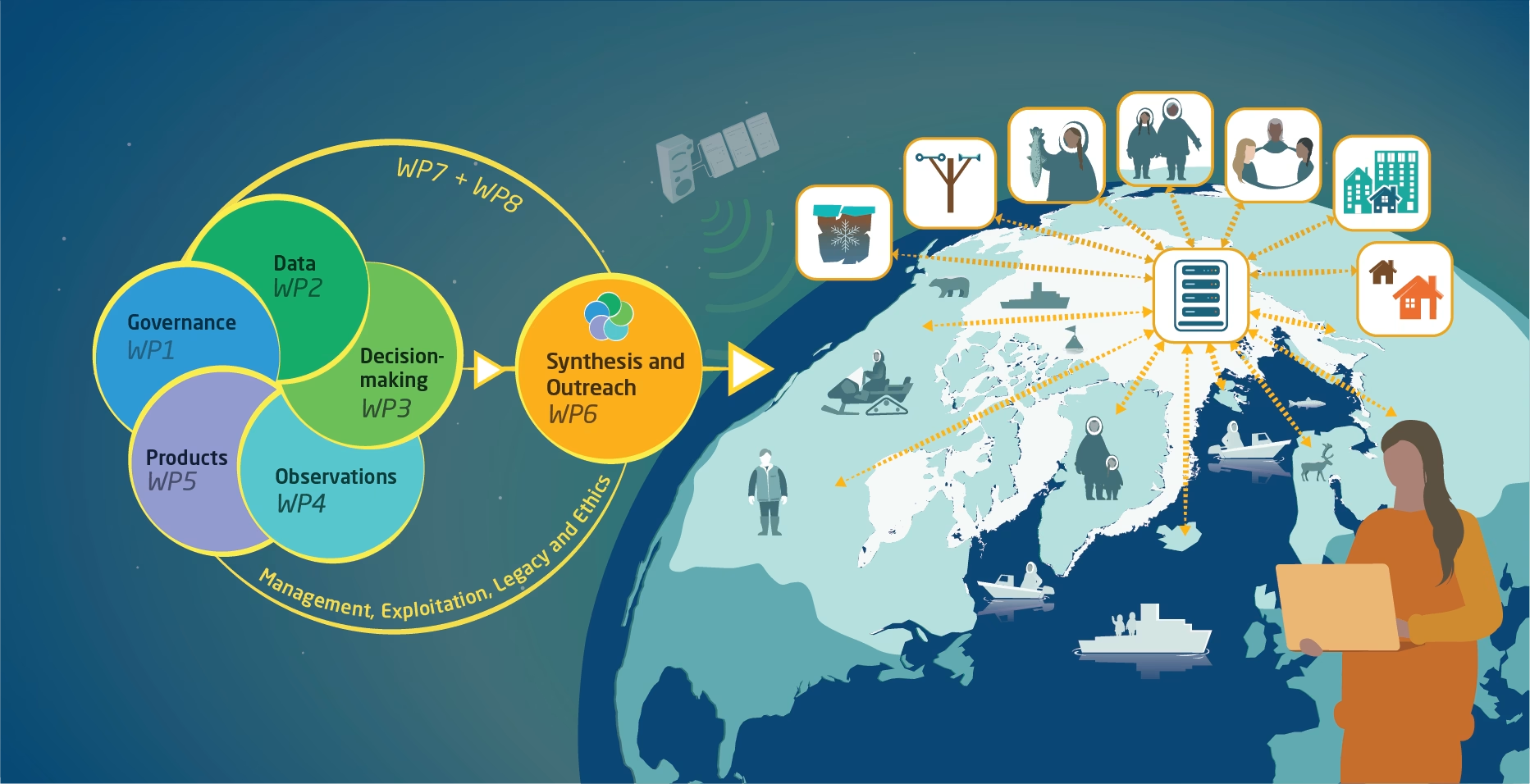
The project is structured around seven interlinked Work Packages:
WP1 Governance & long-term sustainability
WP2 A coordinated Arctic Data System
WP3 Sustainable management & decision-making
WP4 Marine & cryosphere observing systems
WP5 Data products for end users
WP6 Synthesis, dissemination & communication
WP7 Project management, exploitation & legacy
WP8 Ethics requirements
Legacy
Beyond Arctic PASSION will result in a better coordinated, equitable Arctic Observing System of Systems that continues delivering trusted, actionable knowledge long after the project ends.
Who is making it happen?
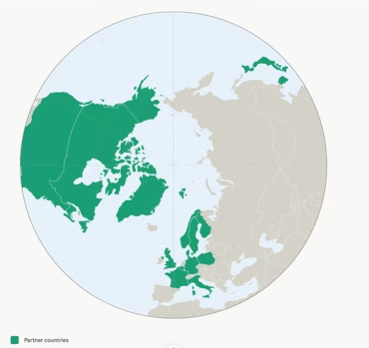
40+ organisations. 15 countries. One shared vision.
European coordination bodies: European Polar Board, SIOS Svalbard Integrated Arctic Earth Observing System, INTERACT - International Network For Terrestrial Research And Monitoring (INPA)
Arctic Council Working Group: Arctic Monitoring and Assessment Programme Secretariat (AMAP)
Indigenous Peoples' organisations: Saami Council, Inuit Circumpolar Council- Canada and Greenland
Early Career organisation: Association of Polar Early Career Scientists (APECS)
Local and regional governance: Arctic Mayors' Forum
Gender and inclusion: Women of the Arctic
Science for policy: European Commission - Joint Research Centre
Science communication: GRID-Arendal
Private science sector: O.A.SYS - Ocean Atmosphere Systems GmbH
Data & Copernicus integration Mercator Ocean, PANGAEA (AWI), Seascape Belgium, Norwegian Meteorological Institute
Canadian Institutes: Arctic Institute of North America, University of Ottawa, Carleton University
European Institutes:
- Denmark: Danish Meteorological Institute, Aarhus University
- Finland: Finnish Meteorological Institute, University of Helsinki, University of Lapland
- France: French National Centre for Scientific Research
- Germany: Alfred Wegener Institute (AWI)
- Greenland: Greenland Institute of Natural Resources
- Italy: National Research Council of Italy, National Institute of Oceanography and Applied Geophysics
- Norway: UiT The Arctic University of Norway, Norwegian Polar Institute, Nansen Center, Institute of Marine Research
- Poland: Institute of Oceanology Polish Academy of Sciences
- UK: British Antarctic Survey, The Alan Turing Institute
- Japanese Institutes: National Institute of Polar Research, Japan Agency for Marine-Earth Science and Technology
- South Korean Institutes: Korea Polar Research Institute
- USA Institutes: University of Washington, University of Colorado, University System of Maryland, University of Alaska Fairbanks
