Who is making it happen?
Beyond Arctic PASSION’s strength lies in its breadth and experience: Indigenous Peoples’ organisations sit alongside national research institutes and universities, operational data services, local government representatives, and industry, spanning Europe, North America, and Asia. This diversity of expertise and perspective is not incidental; it is the foundation that makes a genuinely coordinated, trusted, and equitable observing system possible.
Explore the full partner directory
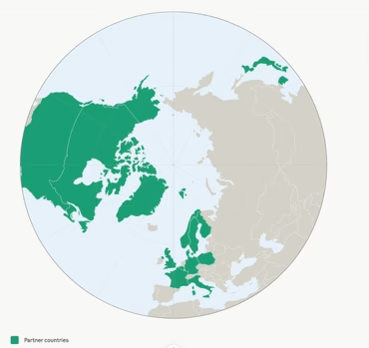
European coordination bodies: European Polar Board, SIOS Svalbard Integrated Arctic Earth Observing System, INTERACT – International Network For Terrestrial Research And Monitoring (INPA)
Arctic Council Working Group: Arctic Monitoring and Assessment Programme Secretariat (AMAP)
Indigenous Peoples’ organisations: Saami Council, Inuit Circumpolar Council- Canada and Greenland
Early Career organisation: Association of Polar Early Career Scientists (APECS)
Local and regional governance: Arctic Mayors’ Forum
Gender and inclusion: Women of the Arctic
Science for policy: European Commission – Joint Research Centre
Science communication: GRID-Arendal
Private science sector: O.A.SYS – Ocean Atmosphere Systems GmbH
Data & Copernicus integration Mercator Ocean, PANGAEA (AWI), Seascape Belgium, Norwegian Meteorological Institute
Canadian Institutes: Arctic Institute of North America, University of Ottawa, Carleton University
European Institutes:
- Denmark: Danish Meteorological Institute, Aarhus University
- Finland: Finnish Meteorological Institute, University of Helsinki, University of Lapland
- France: French National Centre for Scientific Research
- Germany: Alfred Wegener Institute (AWI)
- Greenland: Greenland Institute of Natural Resources
- Italy: National Research Council of Italy, National Institute of Oceanography and Applied Geophysics
- Norway: UiT The Arctic University of Norway, Norwegian Polar Institute, Nansen Center, Institute of Marine Research
- Poland: Institute of Oceanology Polish Academy of Sciences
- UK: British Antarctic Survey, The Alan Turing Institute
- Japanese Institutes: National Institute of Polar Research, Japan Agency for Marine-Earth Science and Technology
- South Korean Institutes: Korea Polar Research Institute
- USA Institutes: University of Washington, University of Colorado, University System of Maryland, University of Alaska Fairbanks
Meet our project team.
Project contacts
Use our contact form and choose who you would like to contact.
The Beyond Arctic PASSION project management and point of contact
Ruta Hamilton
Project Manager, BAS
Michael Karcher, Jeremy Wilkinsons
Co-Leads, AWI and BAS
Jess Richt
Project Support Officer, BAS

(opens in new tab)
(opens in new tab)